
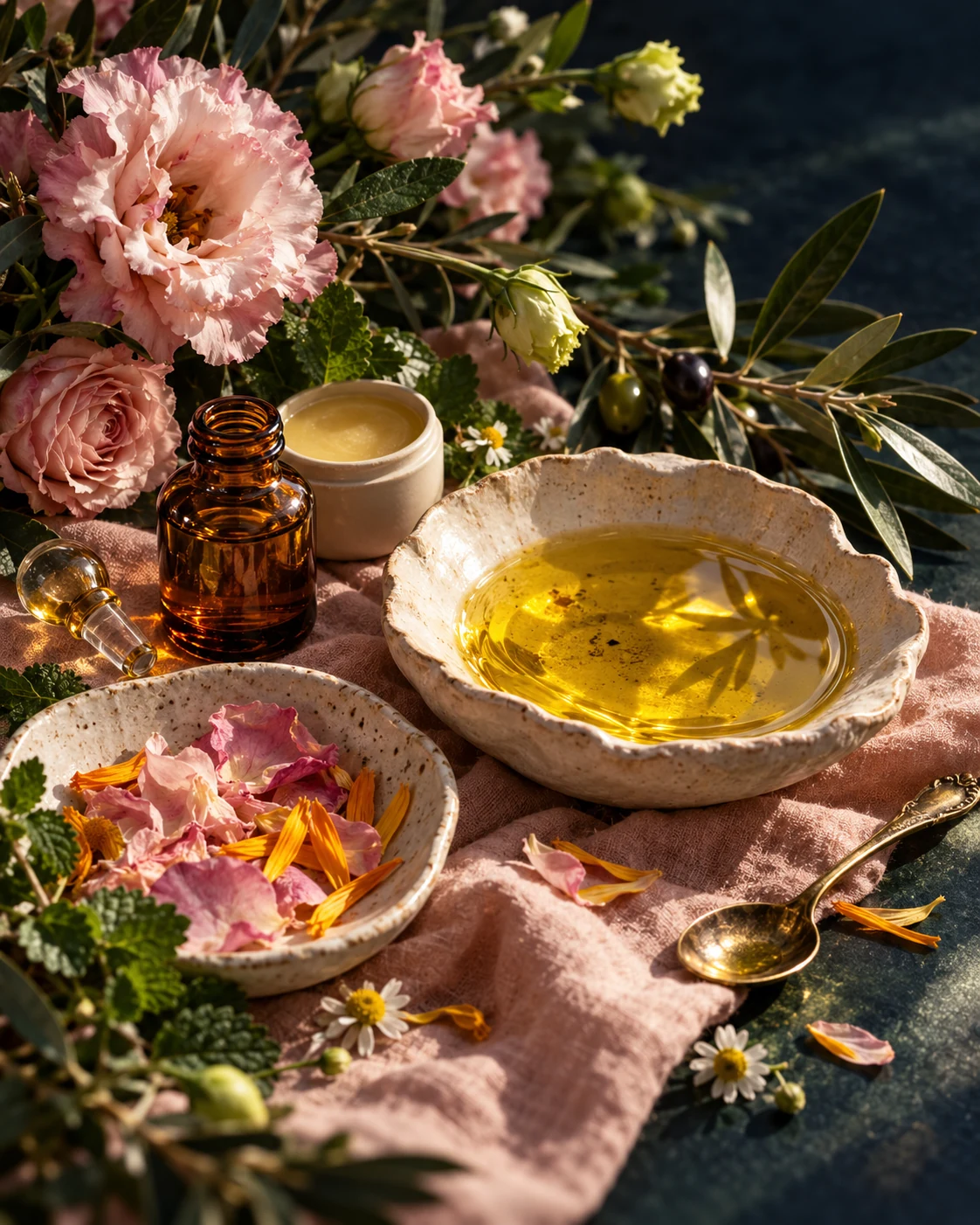
A little oil in a glass bottle can hold an entire botanical story. A seed. A fruit. A harvest. The hands that gathered it, and the knowledge that traveled with it.
That is part of what draws me to an apothecary. I want to know the plant as well as the ingredient list.
But I also want to know the skin receiving it. The oil that feels beautiful on one person may feel heavy or irritating on another. Learning that difference is part of working with plants.
Begin with the preparation
A pressed seed or fruit oil, an herbal infusion, and an essential oil are different preparations. An infused oil carries constituents extracted into its base oil. An essential oil is a concentrated aromatic preparation. They are not interchangeable simply because a plant name appears on the label.
When I look at a bottle, I want clear information: the botanical ingredient, the full formula, its intended use, and how to store it. Is this a facial product? A body oil? A fragrant blend? Does the maker explain what is actually inside?
The romance of the apothecary becomes richer when we know what we are holding.
Olive oil, with context
Olive oil belongs to the Mediterranean world I love: food, trees, village life, and the rituals that gather around them. I want that relationship to remain visible here.
Its place in a meal, however, does not answer every question about applying it directly to skin. In two small mechanistic studies involving 19 adults, repeated olive-oil application reduced measures of outer-skin integrity and caused mild redness. Sunflower oil preserved integrity and improved hydration in the comparison. These were specific oils, applied under particular conditions—not a test of every finished cosmetic containing either ingredient.1
I would not make straight olive oil my default recommendation for eczema-prone skin. We can honor a plant’s cultural place and still be precise about its use. The tradition remains meaningful; the application deserves thought.
The ritual can be personal
My invitation is to choose one skin-appropriate product you already tolerate and spend a little more time with it. Notice its texture, how readily it spreads, and how your skin feels afterward. There is no need to turn the experience into an elaborate sequence.
Place a rose beside the bottle if that speaks to you. Let the flower be an offering of attention. A beautiful object can mark the moment you stop rushing and return to yourself.
For me, that is the soul of a beauty ritual: an everyday act given a little presence.
A few questions for the shelf
Does the product suit the area where you plan to use it? Is it within its recommended shelf life? Has its scent or appearance changed? Can you introduce it on its own, so you can notice your response?
Test a new product on a small area before wider use and stop if it irritates. Botanical fragrance can also trigger reactions; “natural” does not tell us whether a particular formula suits sensitive skin.2 For recurring rashes or persistent symptoms, seek additional care from a qualified clinician or dermatologist.
Choose with curiosity. Keep the plant’s story close. Let your own skin be part of the conversation.
References & further reading
For education and reflection. Individual needs vary. For persistent symptoms or personal guidance, seek additional care from a qualified clinician or appropriate specialist.