There is nothing subtle about the feeling of a bladder infection. The urgency. The burning. That uncomfortable awareness of a part of your body you would much rather forget about for the afternoon.
In this story
When I first wrote this story in 2013, I reached for the foundations of naturopathic medicine: water, medicinal plants, and attention to the body. Those foundations still matter to me. Today, I also want to bring the vaginal microbiome, hormonal transitions, and the emerging science of microbial communities into the conversation.
Because urinary health belongs within a much larger story. One that includes the gut, the vaginal environment, the tissues around the urethra, and the everyday conditions in which we live.
My functional and naturopathic approach begins with a question: what does this particular woman need to feel well, and what is making that harder?
The feminine body is an ecosystem
The bladder, vagina, and gut are distinct environments, yet they are closely connected. Many urinary infections involve Escherichia coli, a bacterium that can live in the intestine and reach the urinary tract. Longitudinal research has linked recurrent UTIs with differences in gut microbial communities, including organisms involved in producing short-chain fatty acids. That invites us to look at the wider ecology; it does not mean a stool result can tell us whether someone has a bladder infection.2
The vaginal environment is especially interesting. Lactobacilli, including Lactobacillus crispatus, can help maintain an acidic environment and influence which other organisms flourish. The aim is a relationship with our resident microbes that supports the tissues they inhabit.
In a small trial of a vaginal L. crispatus preparation, recurrence was lower in the study group, although the overall result remained statistically uncertain. A later trial in 174 premenopausal women found fewer infections with particular vaginal and combined oral–vaginal probiotic preparations. These studies give us a useful direction for individualized prevention: the strain, route, and preparation matter.3, 4
This is why I would want to know exactly what is in a probiotic, why it has been chosen, and what we are hoping to change. A product labeled “women’s health” tells us much less than a well-described strain and a relevant human study.
Perimenopause changes the landscape
Estrogen helps shape the vaginal tissue and microbial environment. As that hormonal landscape changes, some women notice dryness, irritation, discomfort with intimacy, or new urinary symptoms. The tissue around the urethra matters, too. A thoughtful assessment can bring these changes into focus rather than treating every episode of burning as the same problem.1
I would ask about your cycle, life stage, vaginal comfort, sexual health, and the timing of symptoms. What changed before the pattern began? Do symptoms follow intimacy? Is there a sense of incomplete emptying? Has the discomfort continued between confirmed infections? The story helps us choose the right next step.
Begin with the foundations
Let water become an ordinary rhythm. In a trial involving premenopausal women with recurrent infections who drank little fluid, adding water reduced the number of infections over a year. This is a lovely example of a foundational practice receiving serious clinical attention. The amount should fit your needs; people with fluid restrictions need an individualized plan.5
Build meals around nourishment. Vegetables, legumes, whole grains, fruit, adequate protein, and the fats you enjoy can form a generous, sustainable pattern. Introduce fiber at a pace your digestion tolerates. Fermented foods may belong here if they suit you. I see this as tending the wider environment of health, without asking any single food to clear an infection.
Give the body time. Make room for comfortable bathroom breaks, regular bowel habits, sleep, and unhurried meals. Notice products or drinks that repeatedly irritate your own bladder. Keep that observation personal: an irritant is not necessarily the cause of an infection.
Care gently for intimate tissues. Avoid douching and fragranced internal cleansing. If dryness, discomfort, or pelvic tension is part of the picture, seek additional care from a clinician or pelvic-health specialist. Your body does not need to smell like a flower garden to be healthy.
Functional testing, with a clear question
For me, functional testing means looking for meaningful contributors and choosing investigations that can change the plan. A carefully collected basic test can be more useful than a broad panel with no clear clinical question.
| What I want to understand | What may help |
|---|---|
| Is this episode a urinary infection? | Urinalysis and a properly collected urine culture, with susceptibility testing when appropriate. Recurrent symptoms make documentation especially valuable. |
| Could vaginal or vulvar changes be contributing? | A focused examination; vaginal pH, microscopy, or targeted testing for vaginitis when symptoms indicate it. STI testing depends on the history and exposure. |
| Is a broader health issue relevant? | Blood glucose or HbA1c when diabetes risk or symptoms warrant it; kidney-function testing when the history, illness, or proposed care makes it useful. |
| Is the bladder emptying comfortably? | Assessment of pelvic-floor function and, when indicated, a measurement of urine left after voiding. A urology or urogynecology assessment can help with persistent or complex patterns. |
These are examples to discuss, rather than a panel every woman needs.1, 6, 7
Urine PCR and sequencing can detect organisms that conventional culture may miss. In selected cases, a specialist may find them useful, but detecting microbial DNA does not by itself show that a living organism is causing the symptoms. Results need to be read alongside the examination, inflammation, collection method, and clinical history. Commercial stool or vaginal microbiome profiles are not stand-alone diagnostic tests for a UTI or bladder biofilm.1
If symptoms persist despite negative cultures, I would keep investigating the experience: vaginal tissue changes, pelvic-floor dysfunction, vulvar irritation, stones, and bladder pain conditions can all deserve consideration. A negative test should lead to a better question.
The botanical apothecary
Plant medicine has always carried a more textured vocabulary than “kill the bacteria.” Herbalists also speak of soothing, astringency, warmth, fluid movement, and the condition of the tissues. That language encourages us to think about the person experiencing the symptoms.
Cranberry: a plant with a specific role
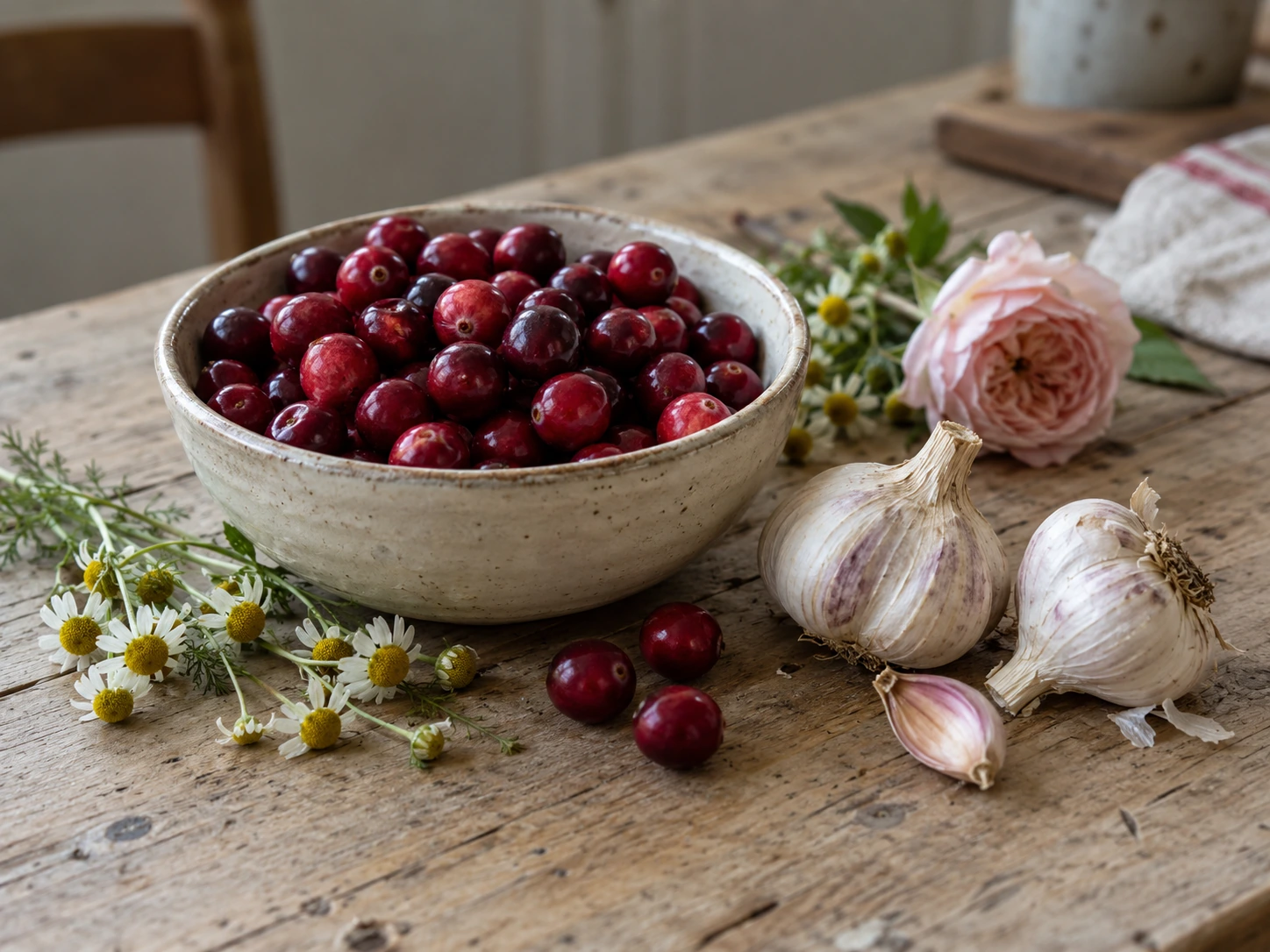
Vaccinium macrocarpon has a long history as food and medicine. Its proanthocyanidins have been studied for their influence on bacterial attachment. Cranberry can be considered within a prevention plan for some women with recurrent infections; preparation and outcomes matter.8
For example, one beverage trial found fewer clinically diagnosed episodes, while its culture-positive outcome did not show the same clear benefit. I would look for a well-characterized preparation and follow confirmed recurrences over time. Cranberry is a prevention tool, rather than a way to establish that an active infection has cleared.9
Corn silk, chamomile, and yarrow
The original version of this article included corn silk, Zea mays, as a soothing urinary herb; chamomile, Matricaria recutita, for its relaxing character; and yarrow, Achillea millefolium, within the traditional botanical conversation. I want to preserve that plant knowledge.
These are distinct plants with distinct preparations. A warm cup of a suitable herbal infusion can also become a moment of care: its fragrance, the warmth in your hands, the permission to pause. Traditional soothing or relaxing uses describe a different aim from demonstrating that bacteria have been cleared. Both the preparation and the purpose deserve to be named.
Uva ursi: respect the plant’s strength
Bearberry leaf, Arctostaphylos uva-ursi, has a longstanding place in urinary herbalism. Its arbutin-containing leaves have been studied for antimicrobial activity, and the European Medicines Agency recognizes specific preparations within a traditional-use framework for mild, recurrent lower urinary symptoms after serious conditions have been excluded.11
This is a plant for a carefully selected, short-term clinical discussion. Human trials have produced a more complicated picture than its laboratory activity alone suggests, including a kidney-infection safety signal in one trial. I would give bearberry the respect of botanical expertise, an appropriate indication, and clear follow-up.12
Natural antimicrobials: the preparation matters
Berberine-containing plants and oregano are often part of functional and naturopathic discussions about microbial balance. They are biologically active, and their mechanisms are worth understanding. Laboratory research has examined oregano constituents in relation to bacterial virulence and biofilm formation, and berberine in relation to bacterial adhesion and invasion.13, 14
The next question is pharmacological as well as botanical: does the chosen preparation reach the relevant tissue, at an effective concentration, with an acceptable safety profile? The cited experiments do not establish a human UTI protocol. I would approach these agents through individualized clinical care, with attention to interactions and the rest of the microbiome. A culinary herb, an extract, and a concentrated essential oil are very different preparations.
Biofilms, enzymes, and N-acetylcysteine
A biofilm is a community of microorganisms associated with a protective matrix. Biofilm research helps explain why microbial behavior can differ from what we see in a simple laboratory culture. Intracellular bacterial reservoirs are another research area; they are not interchangeable with every surface biofilm or every episode of recurrent symptoms.
Functional practitioners may explore N-acetylcysteine, or NAC, and enzyme-based preparations because of research into microbial attachment and matrix disruption. NAC is a thiol compound, not an enzyme. Bromelain is a protein-digesting enzyme preparation; products marketed as “biofilm enzymes” can contain very different ingredients.
Laboratory work has found NAC-related effects on bacterial invasion and biofilms, and a bromelain-based complex combined with NAC has been studied in laboratory and tissue models.15, 16 A small human pilot published in a 2026 journal issue studied NAC in people with ureteral stents. That is an interesting clinical setting, but a stent-associated biofilm is different from an uncomplicated bladder infection.17
These findings deserve a place in the conversation. They do not yet establish that an oral enzyme blend or NAC reliably removes bladder biofilms in women with recurrent UTIs. There is no validated home “biofilm-breaking” protocol I can derive from these studies. In a complex case, I would want a specialist involved and a clear clinical reason for each intervention. New pain or worsening symptoms should prompt reassessment, rather than automatically being called “die-off.”
Supplements: choose a reason for each one
D-mannose is a good example of why I keep reading the research. Its anti-adhesion rationale attracted considerable interest, but a large 2024 placebo-controlled trial did not find a significant reduction in medically attended recurrent UTIs. That changes how confidently I can recommend it for prevention.10
With probiotics, I look at the actual strains and route studied. With cranberry, the preparation and prevention goal. With vitamins and minerals, dietary adequacy and a meaningful reason to investigate a deficiency. A bigger supplement collection is not a more individualized plan.
I want you to understand what each choice is intended to do, how we will assess its value, and when it is time to reconsider.
Water, boundaries, and the deeper feminine
There is also room here for the symbolic life of the body. For me, water evokes movement, receptivity, and the ability to soften around an obstacle. I think of a spring emerging from stone: quiet, persistent, and entirely itself.
Within my own reflection, the bladder can become an invitation to consider boundaries and rhythm. Do I postpone my needs until everything else is finished? Can I let rest belong in the day? What would it feel like to care for this intimate part of myself without embarrassment?
These are contemplative questions, not explanations for why a bacterial infection happened. You have not created an infection by feeling the wrong emotion, lacking femininity, or failing to relax. Spirituality can offer companionship while your physical symptoms receive care.
The Taoist idea of non-forcing is particularly meaningful to me here. I translate it into a simple practice: sit comfortably, feel the support beneath you, and let your breath remain ordinary. Notice where effort can soften. No breath-holding, no performance. Just a moment of being on your own side.
Let the ritual be an act of listening. Let the science help us ask clearer questions. Let the medicine remain personal.
For a fuller exploration, read Women’s Health & Feminine Ecology, visit the microbiome collection, or begin with the everyday practices in The Foundations.
References & further reading
- AUA/CUA/SUFU — Recurrent Uncomplicated Urinary Tract Infections in Women (2025) · Clinical guideline
- Worby et al. — Longitudinal multi-omics analyses link gut microbiome dysbiosis with recurrent urinary tract infections in women (2022) · Longitudinal human microbiome study
- Stapleton et al. — Intravaginal Lactobacillus crispatus for prevention of recurrent urinary tract infection (2011) · Randomized phase 2 trial
- Gupta et al. — Effectiveness of prophylactic oral and/or vaginal probiotic supplementation in preventing recurrent urinary tract infections (2024) · Randomized, double-blind, placebo-controlled trial
- Hooton et al. — Effect of increased daily water intake in premenopausal women with recurrent urinary tract infections (2018) · Randomized clinical trial
- NIDDK — Diagnosis of Bladder Infection in Adults · Clinical testing guidance
- CDC — Clinical Overview of Urinary Tract Infections (2026) · Clinical overview
- NCCIH — Cranberry: Usefulness and Safety · Botanical evidence and safety summary
- Maki et al. — Consumption of a cranberry juice beverage lowered the number of clinical urinary tract infection episodes in women with a recent history of urinary tract infection (2016) · Randomized trial; preparation-specific clinical and culture outcomes
- Hayward et al. — D-mannose for prevention of recurrent urinary tract infection among women (2024) · Randomized placebo-controlled trial
- European Medicines Agency — Uvae ursi folium · Traditional-use herbal monograph
- Gágyor et al. — Herbal treatment with uva ursi extract versus a comparator in women with uncomplicated urinary tract infection (2021) · Randomized clinical trial
- Lee et al. — Antibiofilm and antivirulence activities of oregano oil and its major constituents against uropathogenic Escherichia coli (2017) · Laboratory research
- Petronio et al. — Berberine activity against uropathogenic Escherichia coli (2020) · Cell-culture and insect-model research
- Manoharan et al. — N-acetylcysteine protects bladder epithelial cells from bacterial invasion and displays antibiofilm activity (2021) · Laboratory research
- Recinella et al. — Bromelain-based enzyme complex and N-acetylcysteine: in vitro and ex vivo studies (2024) · Laboratory and tissue research; combination formulation
- Singh et al. — N-acetylcysteine versus probiotics for ureteral-stent-associated biofilms (2026) · Small open-label randomized pilot in patients with ureteral stents
- NIDDK — Symptoms & Causes of Kidney Infection · Symptoms requiring urgent assessment
- Memorial Sloan Kettering — Bromelain · Integrative botanical safety summary
Plant & care notes
New burning, urgency, or recurrent urinary symptoms deserve prompt additional care. Seek urgent assessment for fever, chills, back or side pain, vomiting, or feeling seriously unwell; pregnancy, kidney disease, and immune suppression warrant particular care. Natural support must not delay assessment of an active infection.6, 18
Botanical and supplement choices need review for pregnancy, breastfeeding, allergies, kidney or liver conditions, and interactions. Uva ursi is unsuitable in pregnancy, breastfeeding, and kidney disorders; the EMA monograph limits its duration to no more than one week. Concentrated essential oils and homemade herbal preparations should not be placed in the vagina or urinary tract. Bromelain can cause allergic reactions and may increase bleeding risk; discuss it before surgery or alongside medicines affecting clotting.1911