What woman, at some point in her life, hasn’t wondered what her hormones are trying to tell her?
A cycle that changes. Sleep that becomes lighter. A different relationship with desire, energy, or the body you thought you knew. In my original story, I explored plants that accompany women through these transitions. I still want to make room for that knowledge—and for a more thoughtful conversation about what “balance” means.
A changing body deserves curiosity
Coming off hormonal birth control, pregnancy, postpartum life, and perimenopause are different physiological experiences. They deserve individual attention. A symptom such as acne, fatigue, or an irregular cycle cannot tell us, by itself, that estrogen is “too high” or progesterone is “too low.”
I would begin with your story: what changed, when it changed, how you are sleeping and eating, and what is happening in the wider landscape of your life. The pattern matters.
The goddess, the garden, and the seasons within
I like to use feminine symbolism as a way of asking better questions. Where do you need more independence? More pleasure? More nourishment? Goddess imagery can offer a language for those reflections, whether you experience it spiritually, creatively, or simply as a beautiful story.
A flower on the table. A journal beside the bed. Time outside with no task to complete. These are ways to meet yourself with attention. No woman needs to be perpetually fertile, calm, or radiant to embody the feminine. There is room for change, anger, rest, and reinvention too.
Meet the plants with their stories intact
Vitex: a conversation about the cycle
Vitex agnus-castus, or chaste tree, has a long place in women’s herbal care. Some clinical evidence supports certain premenstrual symptoms, particularly cyclical breast tenderness, but the research does not establish a universal progesterone-balancing effect.
Red clover and soy: understanding phytoestrogens
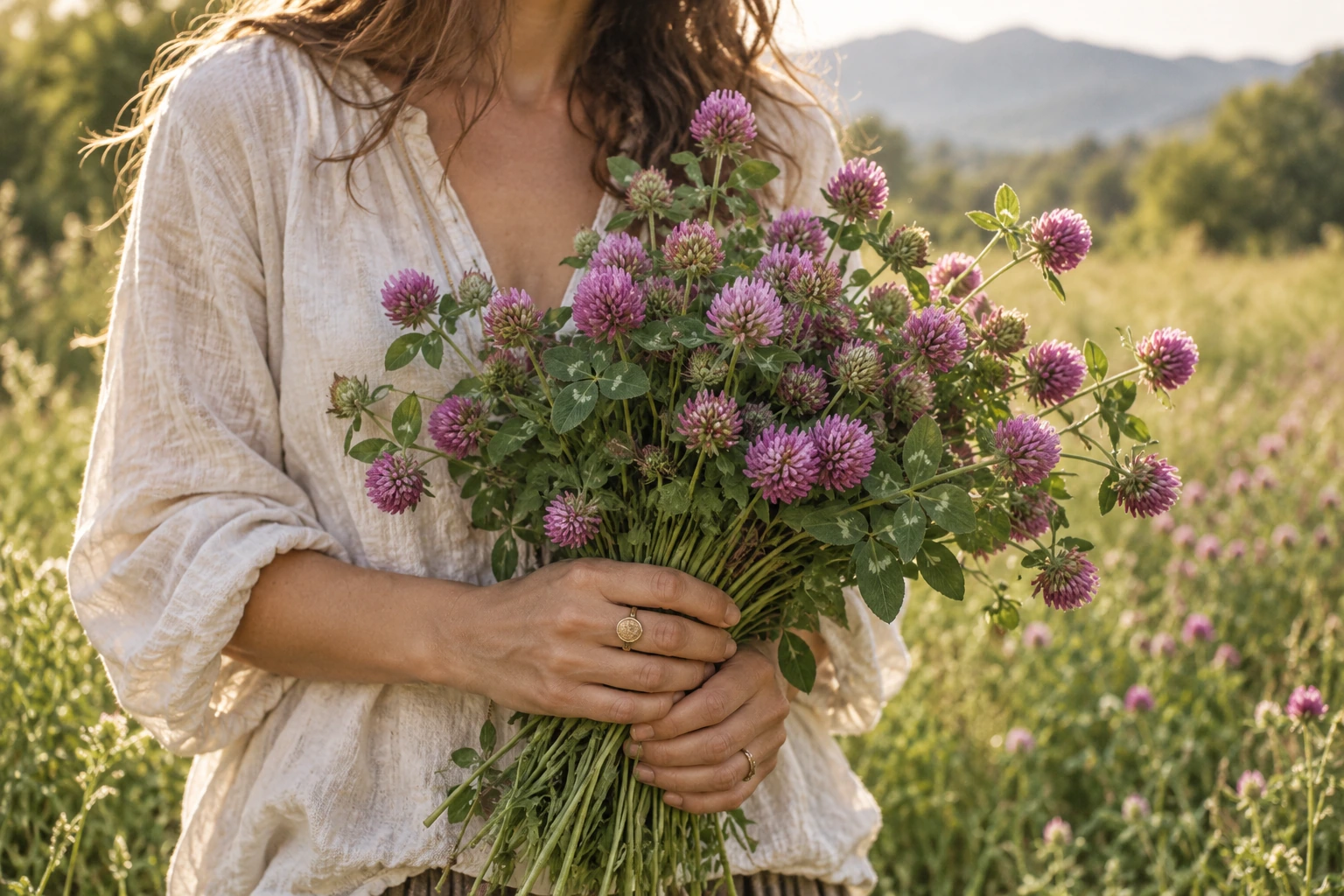
Red clover’s pink-purple flowers and soy’s nourishing foods introduce us to isoflavones, plant compounds with estrogen-like activity. Studies of hot flashes have had mixed results. Some soy preparations may offer a small benefit; red clover findings remain inconsistent. A bowl of edamame or a meal with tofu can belong in a varied diet without becoming a promise to correct your hormones. Concentrated extracts deserve a separate conversation.5, 6
Pomegranate: beauty, symbolism, and an evolving clinical story
The jewel-like seeds invite a sense of abundance. I love that sensory language. The evidence for seed oil and hot flashes is less settled: the original randomized trial did not show a significant advantage over placebo at its twelve-week treatment endpoint. Enjoying the fruit and prescribing an extract are different choices.7
Ginseng: vitality with discernment
Panax ginseng belongs to a rich restorative tradition. Its presence in women’s wellness should not become a claim that it reverses vaginal tissue changes.
DIM, milk thistle, and the language of “detox”
Cruciferous vegetables are welcome at the table. Concentrated DIM is a different intervention: a study showing changes in estrogen metabolites in a particular clinical population does not establish treatment of general “estrogen dominance.” Milk thistle’s traditional liver connection also does not prove that it clears excess estrogen. I would choose vegetables for nourishment and consider extracts only for a clear, individualized purpose.9, 10
Functional labs: begin with the question
The most useful test is one that can change the next step in your care. Bring a cycle calendar and notes about bleeding, sleep, symptoms, and any supplements to the conversation.
- A missing period: pregnancy should be considered when possible. Depending on the history, evaluation may include TSH, prolactin, FSH, and estradiol.2
- Heavy bleeding: a complete blood count can identify anemia. Other testing should follow the clinical picture; routine hormone panels are not the answer to every heavy period.3
- Perimenopause after 45: symptoms and cycle changes often provide the diagnosis. Fluctuating hormone levels mean routine FSH testing is usually unhelpful. Earlier transitions or an unusual presentation may call for testing and specialist assessment.1
A broad panel is not automatically more personal. Results need the context of your age, cycle timing, health history, and the question being asked.
Natural care that gives the body room
Start with a rhythm you can actually live with: enough food, regular meals, a consistent opportunity for sleep, enjoyable movement, and strength-building activity suited to your capacity. Make space to notice which rituals leave you nourished rather than depleted. A tea break can be a pause; it does not need to become a ten-supplement protocol.
I want this season of your life to hold more than a search for “perfect” numbers. There can be knowledge here. And self-trust. And a new way of belonging to your own body.
References & further reading
- NICE NG23 — Menopause: identification and management · Clinical guidance or evidence summary
- ASRM — Current evaluation of amenorrhea (2024) · Clinical committee opinion
- NICE NG88 — Heavy menstrual bleeding: assessment and management · Clinical guidance or evidence summary
- NCCIH — Chasteberry · Evidence and botanical safety summary
- NCCIH — Soy · Evidence and botanical safety summary
- NCCIH — Red Clover · Evidence and botanical safety summary
- Auerbach et al. — Pomegranate seed oil in women with menopausal symptoms (2012) · Randomized placebo-controlled trial
- NCCIH — Asian Ginseng · Evidence and botanical safety summary
- Thomson et al. — A randomized, placebo-controlled trial of diindolylmethane for breast cancer biomarker modulation (2017) · Trial in a specific treatment population; not evidence for general hormone balancing
- NCCIH — Milk Thistle · Evidence and botanical safety summary
Plant & care notes
For ongoing symptoms, seek additional care from a qualified women’s-health clinician or appropriate specialist. Bleeding after menopause, persistent pelvic pain, or very heavy bleeding deserves prompt assessment. Menopause is a life transition; suffering through unexplained symptoms need not be part of its meaning.
Pregnancy, breastfeeding, hormone-sensitive conditions, and possible interactions need individual consideration.4
It can disturb sleep and affect blood sugar or interact with other treatments, so a stimulating herb may be a poor match for someone already feeling wired and exhausted.8