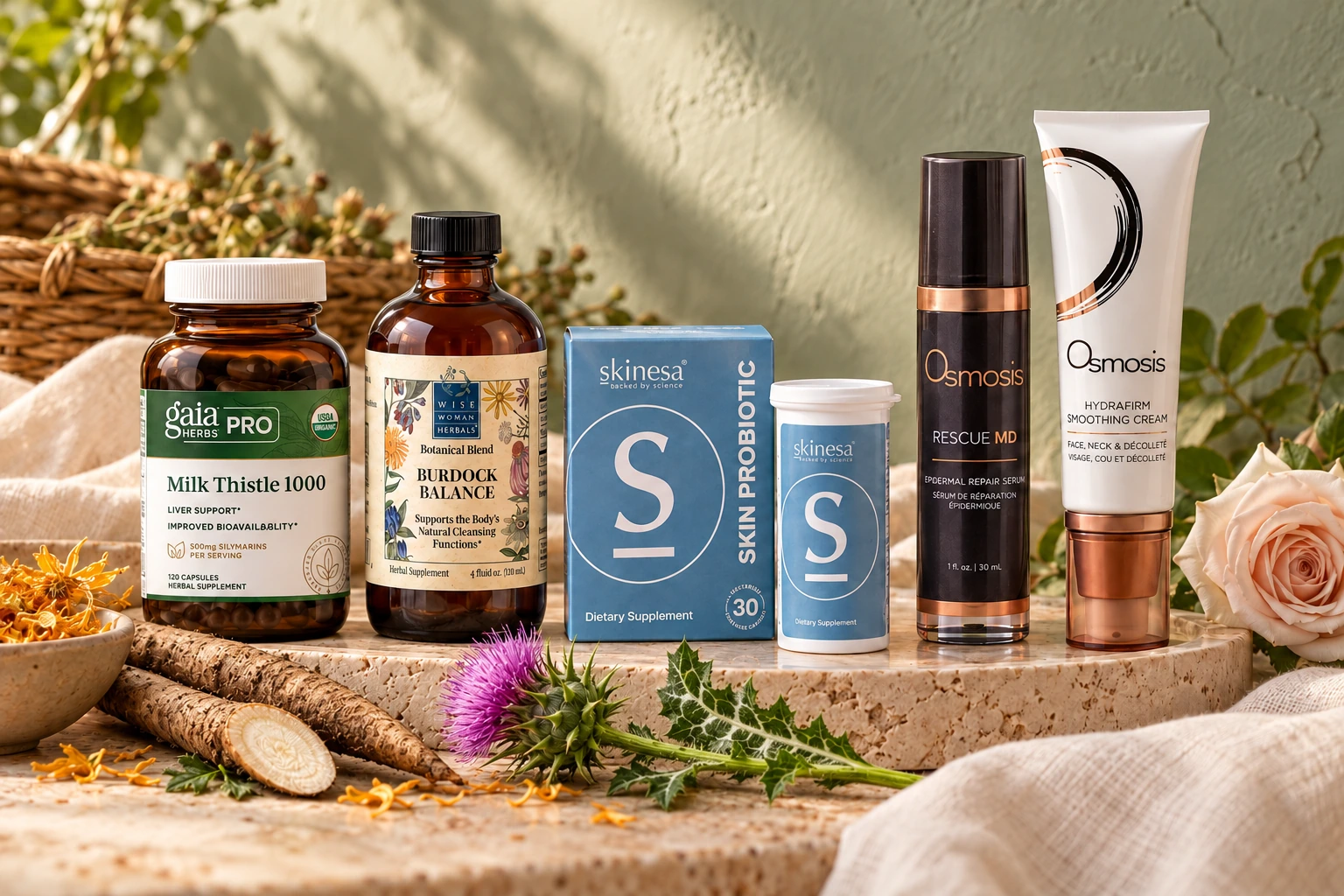
Okay, let’s start with something beautiful: a plate full of color.
In this story
In the original version of this story, I encouraged you to bring more seasonal fruits and vegetables into your day, slowly enough to make the change last. I still love that beginning. Skin care can start in the kitchen, with food that feels nourishing and a little more curiosity about what your body needs.
Feed the living tissue you are in
Skin is a barrier, an immune environment, a sensory organ, and a home for microbial communities. It has nutritional needs, but a breakout is not a moral assessment of your lunch. I want this conversation to feel generous: enough food, more variety, and room to enjoy eating.
Build a meal with vegetables or fruit, a protein source, satisfying carbohydrate, and some fat. Think lentils with roasted carrots and olive oil; eggs or tofu with greens; fish with potatoes and a bright salad. Choose the foods that fit your culture, appetite, and circumstances.
A botanical palette for the plate
- Vitamin C: peppers, citrus, berries, and broccoli contribute a nutrient needed for collagen formation and wound healing. More than you need is not automatically better.1
- Vitamin A: carrots, pumpkin, sweet potato, and dark leafy greens bring provitamin A carotenoids. Vitamin A supports normal cell differentiation; food and concentrated preformed-vitamin supplements have different safety profiles.2
- Zinc: beans, seeds, nuts, seafood, and other protein foods can contribute to intake. Zinc has a role in repair, and deficiency can impair wound healing.3
Seeds belong here too. Flax, pumpkin, sunflower, and sesame can add texture and nourishment. There is not strong evidence that rotating them on a particular menstrual calendar reliably balances hormones or clears acne. Enjoy the seeds you tolerate without turning the meal into an exam.
What food research says about acne
A small randomized trial found improvements with a lower-glycemic-load eating pattern. That is an interesting reason to explore balanced meals with legumes, vegetables, and intact grains; it is not a guarantee for every person or every kind of acne.4
The American Academy of Dermatology’s 2024 guideline found insufficient evidence to make formal recommendations for dietary changes, vitamins, or plant products as acne treatments. Food can support health while persistent acne still deserves individual care.5
If you suspect a food association, change one thing thoughtfully and reassess with help when needed. An increasingly restricted diet can leave you undernourished and make it harder to understand what is actually happening.
The gut–skin conversation
I find the relationship between food, microbes, and skin fascinating. A 2024 randomized trial of a particular oral probiotic reported acne benefits. That finding belongs to the tested formulation and study population; it does not mean every probiotic clears skin, or that a stool report can explain every breakout.6
A varied, fiber-containing diet can belong to your everyday nourishment without needing a microbiome score to approve it. For more on the skin’s own ecology, read Your Skin: A Living Ecosystem.
Basic and functional labs: follow the clues
Before ordering tests, I would want to understand the change: dry skin, inflamed acne, a rash, poor healing, or hair shedding. Your diet, menstrual history, digestion, skincare products, and supplements all help shape the next question.
- Fatigue, hair shedding, or heavy periods
- A clinician may consider a complete blood count and ferritin when anemia or low iron stores are plausible. Dry skin with cold intolerance, constipation, or other thyroid symptoms may prompt thyroid testing.8
- Acne with irregular cycles or new coarse hair growth
- Assessment for androgen excess or PCOS may include total and free testosterone. Acne alone is a relatively weak predictor of biochemical androgen excess.7
- Digestive symptoms or unexplained iron deficiency
- Celiac assessment may be appropriate, commonly starting with total IgA and IgA tissue transglutaminase. Arrange testing before removing gluten from your diet.9
- Possible nutrient deficiency
- Dietary restriction, malabsorption, examination findings, and other risks help decide whether targeted testing is useful. A large micronutrient panel is not a prerequisite for caring for your skin.
There is no single “functional skin panel.” Testing should help answer a specific question, and results need clinical interpretation. Commercial microbiome, cortisol, or urine-hormone panels are not routine explanations for skin symptoms.
Vitamins and supplements: choose a reason
Correcting a deficiency can be important. Taking a beauty stack without knowing what it contains is a different proposition. I would look at the purpose, the total amount across products, the duration, and how we will know whether it is helping.
Burdock root & apple: a new kitchen ritual
Arctium lappa is a plant with both food and herbal traditions. Its cultivated root, known as gobo, is eaten as a vegetable in Japan. European herbal monographs also record traditional use for seborrhoeic skin conditions. That is a meaningful historical connection, while modern clinical proof of skin benefit remains limited.11, 12
Earthy burdock & sweet apple infusion
- 1 tablespoon thinly sliced fresh, food-grade burdock root
- ½ small apple, washed, cored, and sliced
- 2 cups water
- Optional: 1 thin slice of fresh ginger
- Scrub the cultivated burdock root and slice it finely. Use a reliable food supplier rather than an unidentified foraged root.
- Add the root, apple, water, and optional ginger to a small saucepan. Bring to a gentle simmer, cover, and cook for about 15 minutes.
- Strain into two cups. Let it cool to a comfortable temperature and enjoy its earthy, softly sweet flavor.
An occasional culinary drink with an earthy, softly sweet flavor. The quantities are for the kitchen, not a studied skin-treatment dose.
Let beauty care feel nourishing
I think of the kitchen as part of the Goddess Apothecary: color, scent, food, and the act of caring for ourselves. A bowl of soup can be a ritual without needing to flush an organ or promise perfect skin.
References & further reading
- NIH Office of Dietary Supplements — Vitamin C · Evidence and clinical context
- NIH Office of Dietary Supplements — Vitamin A and Carotenoids · Evidence and clinical context
- NIH Office of Dietary Supplements — Zinc · Evidence and clinical context
- Kwon et al. — Clinical and histological effect of a low glycaemic load diet in treatment of acne vulgaris (2012) · Small randomized trial
- American Academy of Dermatology — Updated guidelines for acne management (2024) · Evidence limits for nutrition and botanical acne treatments
- Eguren et al. — A randomized clinical trial of an oral probiotic in acne vulgaris (2024) · Formulation-specific randomized trial
- 2023 International Evidence-based Guideline for the Assessment and Management of PCOS (2023) · Guidance for evaluation of androgen excess
- NICE NG206 — Assessment of persistent fatigue and exclusion of other diagnoses · Context for selected investigations, not routine skin screening
- NICE NG20 — Coeliac disease: recognition, assessment and management · Evidence and clinical context
- FDA — Biotin interference with laboratory tests · Laboratory safety information
- EMA — Community herbal monograph on Arctium lappa L., radix (2010) · Traditional-use monograph and contraindications
- EMA — Assessment report on Arctium lappa L., radix (2010) · Traditional and food-use context
Plant & care notes
Excess preformed vitamin A can harm the liver and can cause birth defects; it does not belong in a casual high-dose beauty protocol. Long-term excess zinc can lower copper and cause harm. Keep these nutrients in perspective, especially when several products overlap.2, 3
Tell your clinician and laboratory about hair–skin–nail supplements before testing. High-dose biotin can distort some laboratory results. Follow their instructions about timing; there is no single pause interval that fits every test and product.10
Persistent, painful, or scarring acne, a changing lesion, or a rash that does not settle deserves additional care from a dermatologist or appropriate specialist. Keep the pleasure of food alongside that care. Both belong in a thoughtful approach to the skin you live in.
Do not substitute extracts or essential oils. Avoid it with burdock or Asteraceae-family allergy. During pregnancy, breastfeeding, or when taking medicines—particularly diuretics—seek individual guidance before using burdock preparations.11